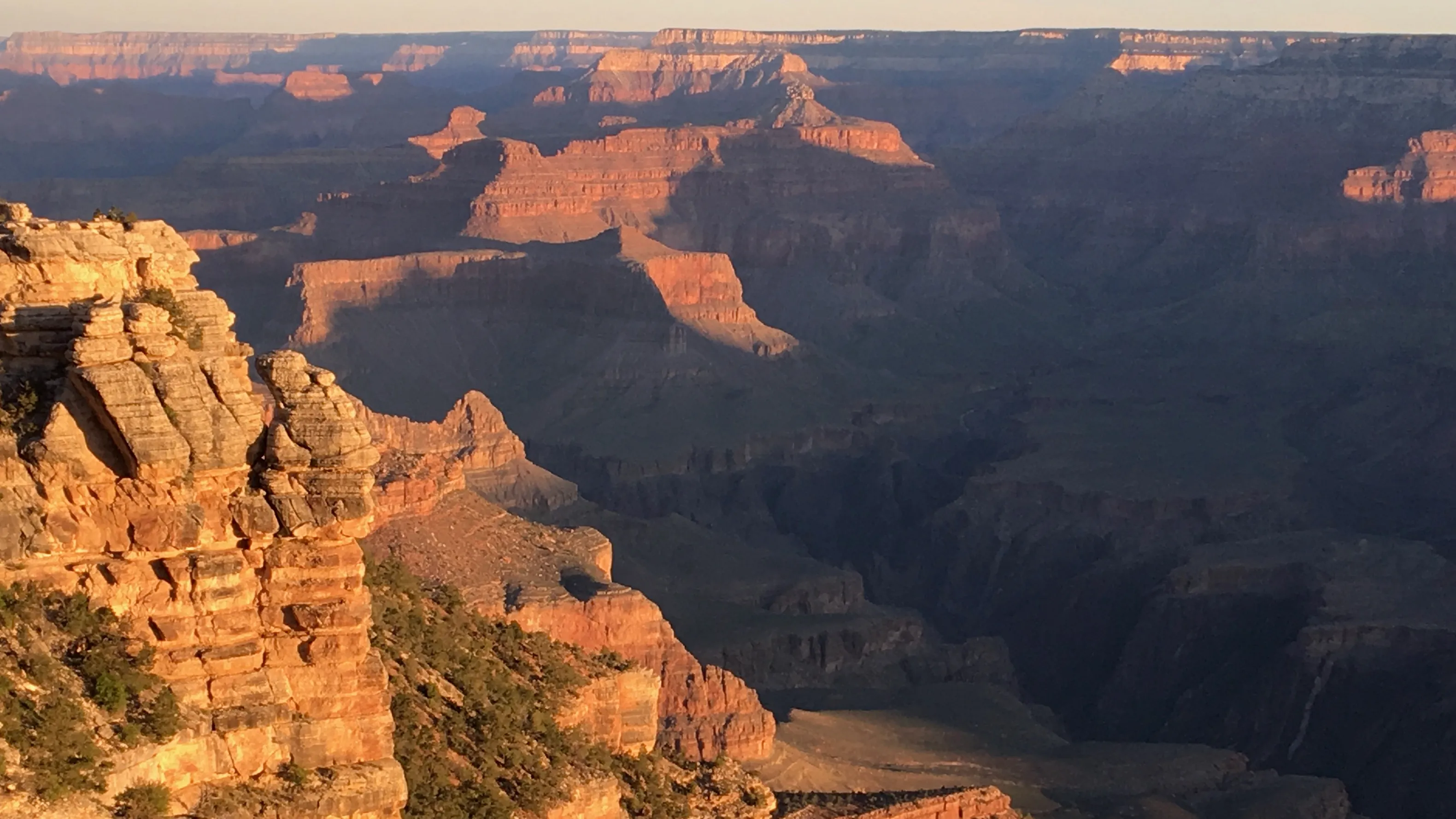
Do I see Beck down there?
About 10 years ago, I had a guitar lick that I had been sitting with for a while. I would play the descending line on its own but it wasn’t really going anywhere. I wasn’t sure how to craft it into anything but a repetitive sequence of notes that sounded kinda cool to me. I knew I wanted it to be a song. I just didn’t know how to get it there.
I kept returning to the lick, trying it out with a chord here and there, hoping it would magically fashion itself into something more complete. It didn’t.
Then one day I happened to listen to The Golden Age by Beck, and noticed that the riff that opens the song had a similar feel to what I had been working on, but it was situated within a beautiful expanse of a song.
When a riff isn’t just a riff
The opening of The Golden Age is deceptively simple. A strummed guitar cycles through three chords with an unhurried pace I wouldn’t have associated with Beck at the time. It’s simple, spacious, rooted in the key of E. When the riff arrives after a couple rounds of the simple chord sequence, it sounds like it comes from somewhere very still.
The first thing I noticed is that the main instrument playing the riff (sounds like a vibraphone) is not playing it solo. There’s a second part underneath it, panned left. It’s quieter, and with a smoother sound, more like a harmonium. At first it moves in unison. You might not even notice it as a separate instrument if you aren’t listening closely. I certainly didn’t. Not until I started studying the song at least.
I noticed that doubling the riff with two different instruments gave it some life mine didn’t have on its own. So I added a double for my riff too and it was a definite improvement. One thing I didn’t notice until I started writing this blog post, however, is that this second part evolves when the riff returns in the outro. Instead of doubling the melody, it begins to harmonize by taking on a different shape, moving down in the scale while the main riff continues its intervals. These differences open a slight gap between the two lines. It’s subtle and sometimes I still have to listen closely to hear it. And it’s something I wish I had incorporated in my own song because it’s more interesting to hear the part harmonize and it provides some movement from the start to the end of the song. The main melody line of the riff persists in the same key, but a new dimension has appeared.
Now when I listen back to The Golden Age next to my song Everything in Place, I can’t help but notice that mine doesn’t do that. It comes back the same way it did in the intro. What I hadn’t understood until now is that a riff returning unchanged is a missed opportunity. A place where the song could grow but doesn’t.
In the past, when I would compare my songs to the music I loved, I felt that the gap between what I was reaching for and what I actually made feel like a failure, which kept me from making my music public. But it doesn’t feel like failure anymore. It feels like information I can use.
One borrowed chord
The Golden Age is harmonically sparse in a way that works beautifully. The verse and intro circle through E, F#m, and A. Over and over. You might even think that the pattern won’t change and this is the song.
The advice I’d heard about writing choruses usually involved coming back to the root of the key as much as possible. But since the song has been steadily returning to E leading up to the chorus, what chords could the chorus use to return to the root when it’s been on the root the whole time? Instead of returning to the root, The Golden Age departs from that advice, and adds a new chord for the first time in the song.
When the chorus arrives, it starts on D, which is a chord we haven’t heard yet. In music theory, the D chord is a borrowed chord from the parallel minor (E minor), which shares that chord, and slips it into an otherwise major-key song. Regardless of the theory, this chord choice turns a sparse song that conjures up the loneliness of driving through the desert at night toward slightly different territory. After all those measures of E, F#m, and A, a D chord allows the song to shift into the reflective focus of the chorus after setting the scene throughout the verses. Even if the chorus settles back into the familiar terrain of A and F#m after a single measure of D, there’s a slight feeling of having been briefly somewhere else and come back.
As I listen for ways to build a song around a riff, I discovered this quiet way a song can create dynamism. If you hold the pattern long enough, a single new element, especially an unexpected chord, can give the song a lift.
Instead of relying on standard songwriting techniques, The Golden Age doesn’t use a key change or a tempo shift to lift the energy of the chorus. I applied the same approach in Everything in Place by having a repetitive three-chord pattern in the verse and then shifting to the borrowed chord in the chorus, albeit in a different key.
When a drone isn’t just a drone
When I was finishing this song all those years ago, I started to wonder how The Golden Age can feel so dynamic even though there’s very little changing harmonically and rhythmically. My song had these similar elements, yet needed something to carry interest through to the end. Something that would increase the intensity ever so slightly and give it a build that seemed to be lacking. That’s when I listened close enough to find the drone that underscores The Golden Age and creates dynamism in ways that I still haven’t completely figured out.
The Golden Age’s lyrics are full of open landscape, distance, and the kind of solitude that’s almost physical. It delivers you into a scene where you can picture yourself battling your demons by driving through the desert all night. The atmosphere of the song uses a drone, something that sounds like a long held note, as an undercurrent, starting off as a low wobble underneath the chords. An echo that by the end turns into the main part and elevates the song from a sad driving song to something altogether different.
Technically, I think there’s a synth or some other drone note that is phase shifting rather than changing pitch. There’s probably multiple effects happening at once, but when I listen I don’t hear the pitch drifting. It sounds to me like the phase is moving around in space, which gives the sound a slow, oceanic swell without actually going anywhere melodically.
The drone effects work in concert with effects applied to other elements. The vocal reverb contributes to this feeling of movement by becoming slightly ambient as it expands into the space partially filled by the drone. As the song goes on, it’s harder to say where one ends and the other begins.
At the end of the song, the drone is all there is. The guitar strum has receded along with the riff and the layers that have been built on top of it. We’re left with that echo now at the center. All of the instruments have collapsed into it, and I get the sense that we’ve somehow been absorbed into the atmosphere of the sound.
I tried to capture that same dynamism by adding a drone note that would carry through my song too. I added effects that I thought would alter the sound throughout the song enough to create a similar dynamism. I aimed for the effects that would add sonic interest, but I now see the drone as a structural idea, not just a production one. As the song gets gradually overtaken by the drone, I see it now as a signal for how the sense of space provided by the desert can somehow make the loneliness feel right.
When I tried the drone technique in Everything in Place, I wasn’t considering how it might carry a different weight than it does in The Golden Age. Everything in Place hints at the anxious distance of separation, and then the warmth of return when you realize your fear is in your mind and she’s right there. Which is a hard thing to capture in a sound. Drones are inherently static and The Golden Age creates movement through effects, but in that song it commits to a feeling and holds it. It doesn’t resolve in a way that might shift from unease into closeness. It just gets more intense. I realize now that mine kept running into the limits of what the tool can do or what I was capable of making it do.
Has it really been 24 years?
I didn’t hear Sea Change when it came out. I remember reading a Rolling Stone feature in 2002 (which I think was being delivered to my apartment by mistake) where they gave it five stars and a glowing review. This probably stands out in my memory because it was strange for me to pay attention to at the time (still is). I don’t know if I cared what albums they gave five stars to before then or since. I’d listened to Beck, had sung and laughed along with Loser on the radio and in Spanish class (Yo soy un perdador?), and watched the psychedelic cowboy line dance in the Where It’s At video, but had never owned an album of his. And being a broke grad student at the time, I did not rush out to buy the album, nor was there any streaming access back then (I hadn’t figured out BitTorrent yet).
I came to it later, through friends, and eventually listened to it repeatedly. I saw Beck live once, at the Ryman in Nashville, with my wife when he was on tour for Morning Phase, which is probably the album that’s closest to Sea Change in tone. He played a lot of the songs you’d expect, but he didn’t play The Golden Age. I remember noticing that absence, but it made sense to me that he would choose more uptempo songs to play.
Since then I listened to it a bunch when I was writing and recording Everything in Place and even more this past month. I spent more time with it in the last few weeks than I ever have before, and I think I understand something about it I didn’t before. Not just the borrowed chord or the atmospheric production or the harmonized outro.
What started as a way to build a song around a guitar lick taught me that choosing the right sounds and effects that help create the atmosphere of a song is about more than just creating sonic interest. I’m not sure I know exactly how I’ll approach it next time, but I know a little more now about what I might do differently. In the end The Golden Age did help me finish Everything in Place even if it’s not quite where I want it to be. When my wife listened to it she said she thought it sounded like Wilco, and I’m not sure anyone will notice how much I’m ripping Beck off, which is I guess how it’s supposed to work. You can listen to it on Bandcamp.