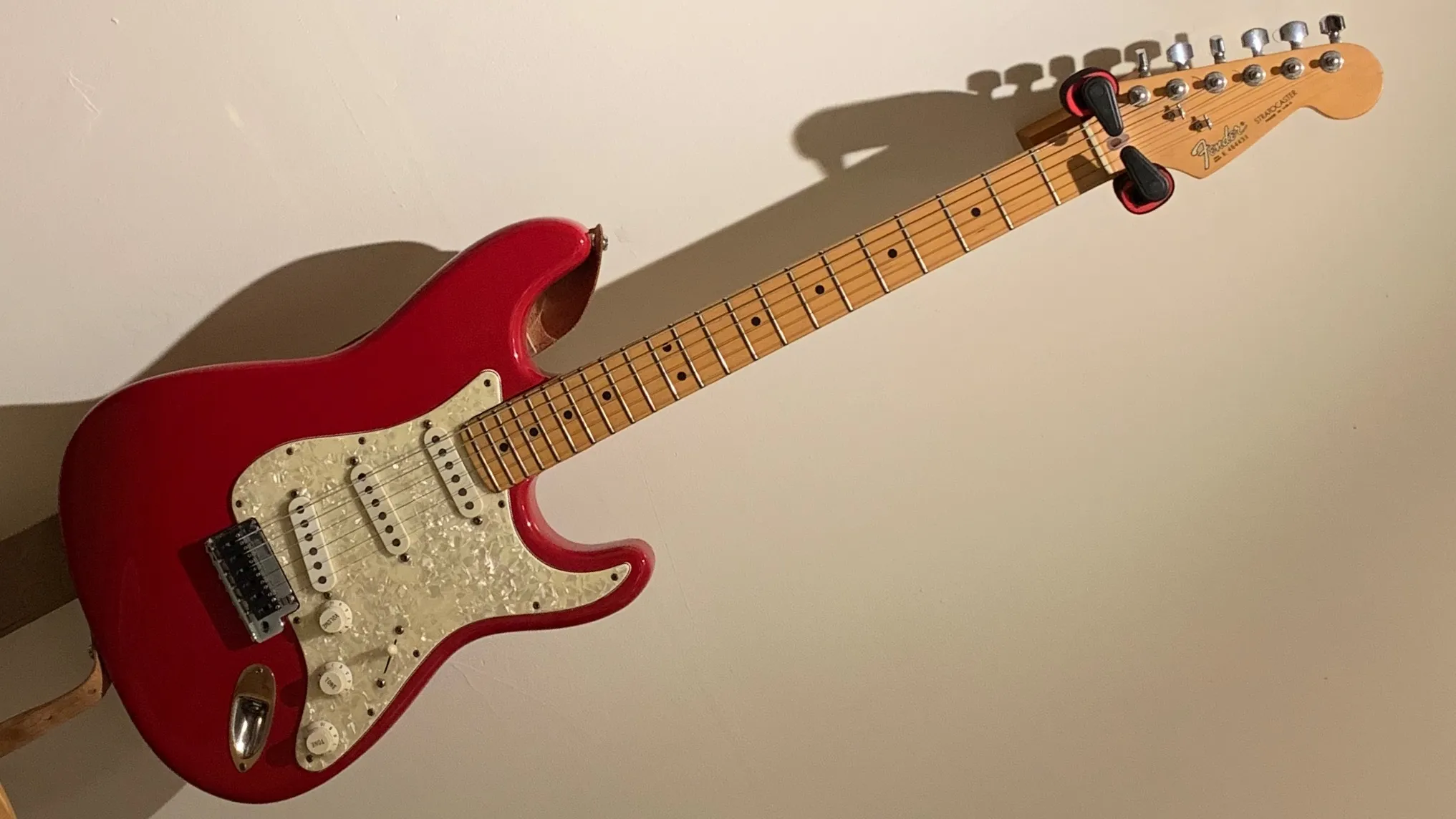
Still missing that whammy bar
I wanted a Fender Stratocaster because of Jimi Hendrix. That was the whole reason. I was twelve, and I’d been playing guitar for a year on an old acoustic my dad had, and it was hard to play on, especially songs like “The Wind Cries Mary”, and I knew that I needed a Stratocaster if I was going to play like him. That’s what Jimi played. That’s what I needed.
My dad surprised me with a used one for my thirteenth birthday. Red, with a pearl pickguard. I still have it. It might be oldest possession. Even though I’ve held onto it, I’m not the best at keeping my stuff pristine. At some point in high school I broke the whammy bar (probably trying too hard to sound like Hendrix) and I never replaced it.
When I was in high school, I listened to cassettes my guitar teacher recorded for me of Jimi’s records so obsessively that my family would tell me to stop playing them around the house and in the car. I wrote songs my bandmates said sounded like Hendrix worship. They weren’t wrong. I was deep in it.
But early on, I had mainly listened to the first album, “Are you experienced,” which has some of his best known songs like “Purple Haze”, “Foxy Lady” and “Fire,” so when I finally heard “Little Wing” at a friend’s house in high school it floored me. This sounded nothing like those more famous songs, and after 30 years, it’s still the song of his that I think I can learn the most from.
Spectacle vs Meaning
There’s a quote from Hendrix that stuck with me ever since I read it. He was talking about his stage show, the guitar burning, the teeth-playing, playing behind his back, and he said:
“The crowd started to want those things more than the music. Those little things that were just added on, like frosting, you know, became the most important. Things got changed around.”
So, those famous song like “Purple Haze” had made him a rock star, but perhaps “Little Wing” sounds like what he actually wanted to be. I read that and, with all the hubris of a sixteen-year-old who’d been playing for five years, decided I wasn’t going to fall into the same trap. That the music I would write would be enough and I could shun the spectacle. It’s funny to even write that now. Of course I had nothing to worry about besides getting better and having fun with my friends, but that’s who I was then.
Jimi makes the contrast clear when he talked about his inspiration for the song in almost mystical ways, unlike his famous songs that reference drugs and sex. He said he was in Monterey and he had a quiet moment where he was taking everything in. “So I figured that I take everything I see around and put it maybe in the form of a girl, or something like that, and call it ‘Little Wing,’ and then it will just fly away.” He added that it was “one of the very few I like.”
Song Forms
“Little Wing” is two minutes and twenty-six seconds long. Two vocal verses, but no chorus. The same chord progression plays through the intro, both verses, and then once more under the solo. No bridge, no harmonic development, no song arc in the traditional sense. Just passes over the same harmonic terrain, each one a little deeper.
The chord progression works without needing help from a conventional structure. It flows through the chords in a way that doesn’t resemble any particular form. Em → G → Am → Em → Bm → B♭m → Am → G → F → C → D. The B♭m is a passing chord that softens the descent back toward Am. The F major is a borrowed chord that doesn’t belong in E minor and the C and D carry you back to where it started. It doesn’t stop anywhere. It just keeps circling.
This reminds me in some ways of the blues. The blues logic underlying the form works through repetition and call and response. The twelve-bar blues doesn’t modulate to a chorus or a bridge, it circles the same progression, over and over. That cycle of familiar chords, along with the repetition of lyrics and themes of love lost can now feel old fashioned. But “Little Wing” works the same way, and I finally heard it this month. “Little Wing” also repeats its chord progression, never offers a contrasting section to release the tension or provide harmonic contrast. It definitely differs from the blues harmonically; it doesn’t follow a strict I-IV-V structure, but rather flows through those chords with chromatic flourishes. The impact for me is the same. There’s one progression, repeated, with meaning accumulating through each pass. Even the end of the progression has something of a turnaround to it. The G9→F9→C→D run before the progression resets doesn’t resolve so much as it generates forward momentum, pulling us back to bar one. The turnaround functions in much the same way in the blues, and is often a place where more chromaticism is employed.
Hendrix, though, described his inspiration differently. He said the song is “based on a very, very simple American Indian style.” The title “Little Wing” has since been traced to the Anitskiswa, or “Bird Clan” of the Cherokee Nation: beings who, in Cherokee mythology, served as messengers between the People and the Creator. Before doing a little research this month, I was familiar with the idea that he based it on a Native American style, but had no idea of the association to the mythology. But it adds a layer to the song that I wasn’t aware of before. In thinking of the song’s lyrics I often associated the Little Wing figure as a sort of idealized version of a girl who was always there to ease a man’s worries. But the mythological connotation of birds moving between worlds resonates differently than “a girl with butterflies and moonbeams.” It makes her something like spiritual guide that accompanies you not because you’ve earned it, but in a older way that connects with many religious traditions. Of course, the blues also can employ such fantastical and spiritual figures.
What is a Whammy Bar for?
As I’ve listened to it this month, I’ve loved rediscovering “Little Wing“‘s patience with its own payoff.
It opens with just guitar and glockenspiel that complements the guitar with sparse bell-like tones. No other instruments are heard until the end of the first round of the chord progression, where the drums spring to life with one of Mitch Mitchell’s famous fills. The second time through the progression, there’s more weight, more momentum added by the drums and bass. And Jimi’s singing is restrained and soulful through both verses. By the time we reach the solo, the song has accumulated enough tension that the guitar solo doesn’t need to introduce anything new harmonically. It’s another round of the chord progression except at peak intensity.
Before it arrives, I keep returning to how Hendrix transitions to the solo. He plays a harmonic bar at the 12th fret and slowly bends the pitches down with the whammy bar until the note warps and fades. It sounds like something winding down. Like stepping on the brakes before taking off again.
By Hendrix’s standards the solo is restrained. This is not “All Along the Watchtower” where he transitions through multiple guitar sounds, each one more fantastic than what came before. Instead, it has a melodic, almost vocal line that feels like a third verse of lyrics translated to guitar. It’s a crucial part of the song, and I’ve begun to think of the solo as Little Wing, flying away. The opening of the solo has become such an essential element of the song that it seems like all covers incorporate at least those first few notes of the solo. Some versions even turn it into a vocal part.
Old and new
“Little Wing” breaks most of the rules I’ve encountered about songwriting. No chorus. No hook in the traditional pop sense. No dramatic structural development. And yet it’s one of the pillars of guitar rock, covered by Sting, Santana, Jeff Beck, Eric Clapton, the list goes on.
In thinking about both the blues form and “Little Wing” together, it strikes me that Jimi wasn’t ignoring the rules of pop songwriting so much as reaching past them toward older, deeper structures. The verse-chorus-bridge structure of popular songwriting evolved from Tin Pan Alley and other forms like the blues. I’m thinking about his reference to Native American music and other folk music that doesn’t follow what has become orthodox song structure. And I think that’s why it still hits me the way it did when I was sixteen, sitting in my friend’s bedroom, hearing it for the first time. It wasn’t just that it was a feat of guitar virtuosity, although it is. Instead, it sounded like something was alive in it that I hadn’t heard anywhere else.
He seemed to know that some songs benefit from a repeated progression more than others. After “Little Wing” he experimented with the blues and other forms, but also continued to write songs that were closer to pop music. “Little Wing” feels like him choosing a form for what he had to say. That’s the thing I want to carry into my own writing: not the wholesale adoption of traditional song forms, but the habit of asking whether the form I’m reaching for by default is actually the right one for this particular song. A chorus might work for some songs but not others. Some songs might create meaning not by landing on an emotional anchor, but from circling and developing through repetition and atmosphere. I want to start paying attention to what the song might be telling me about what shape it needs to be.
My Stratocaster is sitting in my office right now, and I don’t play it much. I’ve given up any pretensions that I’ll have the problems that Jimi did when he wanted to move away from the spectacle. But as I continue to write songs, I’ll think I’ll experiment with deliberately combining old and new and figure out where that takes me.